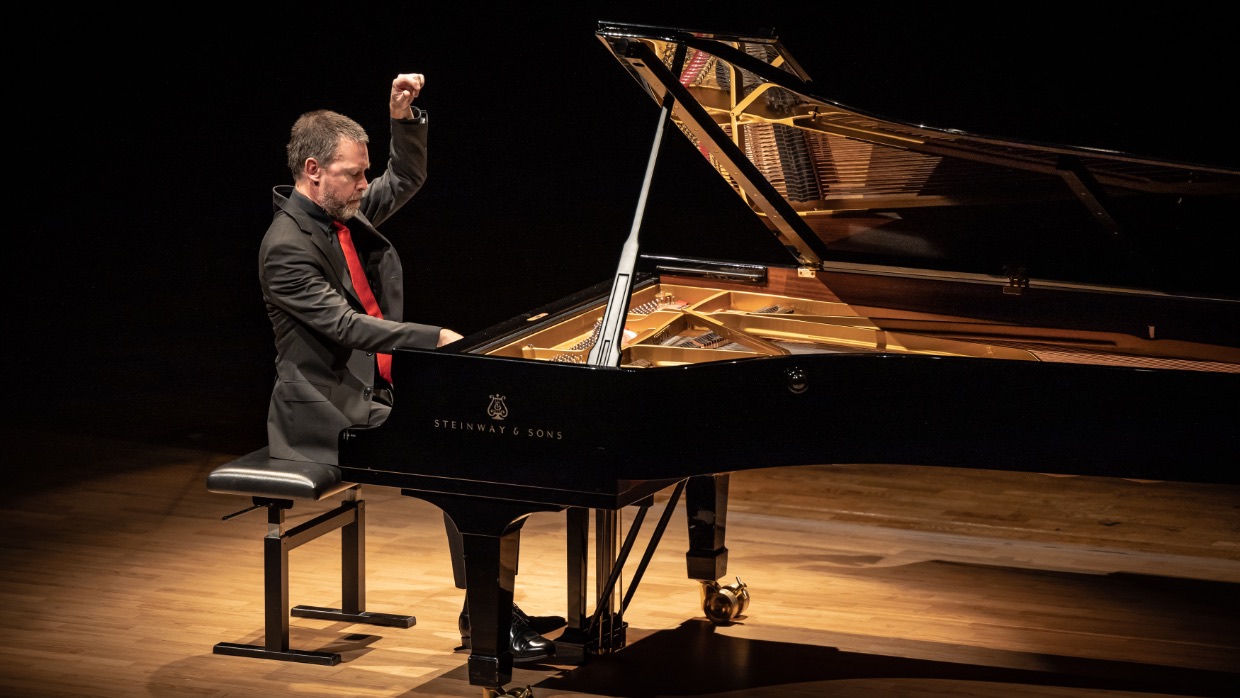
One video is all you need — recordings from any year are welcome, no new filming required.
APPLY NOW →20 January 2027
Applications close at 23:59 CET (Central European Time).
Submit your application and performance video by the deadline to be considered for the 2027 edition of the ÉTUDES International Piano Competition.
Where technique becomes
music.
Chopin, Liszt, Rachmaninoff, Scriabin, Ligeti — the piano étude is one of the truest mirrors of an artist’s voice. ÉTUDES invites pianists of every generation to share a single video from their repertoire — whether newly filmed or an existing unedited recording from any earlier year.
Beyond the awards: selected pianists — including those without a prize — may be featured in our Performance Highlights. Full performances or memorable musical excerpts can be shared through official ÉTUDES channels, with separate permission. Editorial selection is independent of the prize results and is not guaranteed.
Enter Your Performance
One short page, one video. Recordings from any year are accepted — no new filming required.
Age Divisions
Eligibility is determined strictly by year of birth. Conservatory students and professional pianists aged 18+ enter Young Artist or Open.
| Division | Year of Birth | Max Duration | Fee | |
|---|---|---|---|---|
| Young Pianists · Up to 7 minutes · €45 | ||||
| Discovery | 2019 or later | 7 min | €45 | Select → |
| Junior A | 2017–2018 | 7 min | €45 | Select → |
| Junior B | 2015–2016 | 7 min | €45 | Select → |
| Youth · Up to 10 minutes · €55 | ||||
| Junior C | 2013–2014 | 10 min | €55 | Select → |
| Youth A | 2011–2012 | 10 min | €55 | Select → |
| Youth B | 2009–2010 | 10 min | €55 | Select → |
| Young Artist & Open · Up to 12 minutes · €65 | ||||
| Young Artist | 2002–2008 | 12 min | €65 | Select → |
| Open | 2001 or earlier | 12 min | €65 | Select → |
Amateur Division
Dedicated adult pianists (born in 2008 or earlier) for whom piano performance or piano teaching is not their primary profession, and who do not hold — nor are currently enrolled in — a conservatory or university degree in piano performance or piano pedagogy.
Childhood music school training, private lessons, chamber music, or university degrees in any other field are completely fine. You may enter Amateur regardless of how advanced your repertoire is, as long as piano is not your profession.
Evaluated separately from Young Artist and Open divisions, with the same artistic respect and full laureate distinctions (First, Second, Third Prize & Honorable Mention). You may also add any matching Specialist category for +€30 using the same recording.
Seven Specialist Categories
Czerny & Master Études
Concert études and master cycles by Czerny, Scriabin, Debussy, Saint-Saëns, Moszkowski, Prokofiev, Brahms, Alkan, and peers.
Virtuoso Works & Toccatas
Demanding concert solo pieces from any period, including single movements from larger cycles (such as Ravel’s Scarbo or Ondine, Balakirev’s Islamey, Prokofiev’s Toccata Op. 11, or Stravinsky’s Petrushka).
Études since 1950
Concert études composed from 1950 onward — including Kapustin, Ligeti, Bolcom, Chin, Ohana, and contemporary classical or jazz-idiom works.
The étude.
Beyond technique.
One complete work. One video. Recordings from any year are accepted.
Bring the piece that speaks for you
You do not need to prepare a multi-round recital programme. Choose one complete piano étude — or a major virtuoso concert piece in Category 06 — that captures your finest playing today.
| Division | Year of Birth | Maximum |
|---|---|---|
| Discovery · Junior A · Junior B | 2015 or later | 7 min |
| Junior C · Youth A · Youth B | 2009–2014 | 10 min |
| Young Artist · Open | 2008 or earlier | 12 min |
| Amateur (non-professional) | 2008 or earlier | 12 min |
The Evaluation Concept
All submissions are evaluated by a jury of professional concert pianists. Both jury members and participants remain anonymous throughout the adjudication process: recordings are reviewed without biographies, institutional affiliations, or teacher names.
Each entered division is assessed independently on a 100-point scale. Distinctions are awarded according to the achieved score threshold (see Awards).
Why Double-Blind Adjudication?
Our double-blind approach is designed to keep the focus on the performance itself — giving every pianist the freedom to present an individual artistic vision.
Play your own musical vision without tailoring your style to specific jurors.
Every recording is judged purely by ear — without biographies, conservatoire names, or teacher credits.
Our jurors are internationally active concert pianists and educators who evaluate in complete confidentiality, free from external influence.
Assessment Criteria
Performances are scored across four equal pianistic and musical dimensions (25 points each, 100 points in total):
Technical Control
Precision, articulation, evenness, rhythmic stability, and physical command of the étude’s specific technical demands.
Tone & Interpretation
Sound quality, voicing, phrasing, dynamic differentiation, and pedalling control.
Stylistic Fidelity
Idiomatic understanding of the composer’s language, tempo conception, and structural clarity.
Artistic Coherence
Musical architecture across the complete work, poise, and concert-level maturity.
Scoring & Equal Results
Each juror awards up to 25 points in each of the four criteria, for a maximum of 100 points. The final score is the arithmetic mean of the jurors’ totals, rounded to the nearest whole point (0.5 rounded upward). Equal final scores receive the same prize tier, except that only one Grand Prix may be awarded per edition.
If more than one entry receives 100 points, the Grand Prix is decided by the higher unrounded mean for Artistic Coherence, followed by Tone & Interpretation, Stylistic Fidelity and Technical Control. If still tied, the jury decides by documented deliberation. Any other 100-point entry receives First Prize.
Recognition Beyond Prizes
Artistic recognition does not end with the prize list. Every eligible submission is considered for adjudication, and ÉTUDES may also select compelling performances and individual musical moments for its editorial features — including recordings by pianists who receive no award.
Our Performance Highlights may present a complete interpretation or a short excerpt that captures a distinctive musical idea: a remarkable sound, an imaginative phrase, exceptional control, or a memorable artistic moment. These selections are independent of the competition's prize rankings.
Selected artists may receive an opportunity to be featured on the official ÉTUDES website and social media channels, with their name, performance and chosen repertoire credited. This offers an additional avenue for artistic visibility beyond the official results; it is not a prize, a paid promotional service or a guarantee of audience reach.
Publication is always optional. We contact selected pianists separately and obtain their explicit permission before sharing any recording or excerpt. For minors, permission from a parent or legal guardian is required. Refusing publication has no effect on evaluation, results or eligibility.
Written Commentary & Future Editions
An optional Written Jury Commentary (+€35) summarizing the evaluation across these four criteria may be requested during application. Up to four top laureates per edition may be selected at the organisers’ discretion for an invitation to a future jury panel. No award or opt-in guarantees an invitation.
Competition Distinctions
Every entered division is judged independently. Distinctions reflect the artistic level achieved on the 100-point scale rather than rigid quotas.
| Distinction | Score | Notes |
|---|---|---|
| Grand Prix — €500 | 100 points | At most one extraordinary performance per edition |
| First Prize | 95–99 points | Conferred per division |
| Second Prize | 90–94 points | Conferred per division |
| Third Prize | 85–89 points | Conferred per division |
| Honorable Mention | 80–84 points | Conferred per division |
Invitation to the Jury
Up to four top laureates per edition may be selected for an invitation to a future ÉTUDES jury panel. Invitations are made individually at the organisers’ discretion; receiving an award or opting in does not guarantee selection.
Teacher Recognition
Teachers and professors of First Prize and Grand Prix laureates receive an official Teacher Distinction Diploma (PDF) free of charge.
An official Digital Diploma (PDF) is included with every entry. An embossed Printed Diploma & Engraved Medal (+€45) may be ordered for worldwide delivery.
Special artistic distinctions may be awarded for exceptional stylistic sensitivity or contemporary repertoire performance.
| Entry / Service | Details | Fee |
|---|---|---|
| Discovery · Junior A · Junior B | Born 2015 or later | €45 |
| Junior C · Youth A · Youth B | Born 2009–2014 | €55 |
| Young Artist · Open | Born 2008 or earlier | €65 |
| Amateur | Born 2008 or earlier · Non-professional adults without a piano degree | €55 |
| Specialist Category (with Age / Amateur Division) | Same recording · all 7 repertoire categories | +€30 |
| Specialist Category (Standalone) | Without an Age Division | €65 |
| Digital Diploma (PDF) | Official competition certificate | Included |
| Written Jury Commentary | Personal artistic & technical notes | +€35 |
| Printed Diploma & Engraved Medal | Archival embossed certificate & medal (worldwide shipping) | +€45 |
| Second Contrasting Recording | Additional étude video evaluation | +€35 |
| Combined Entry Advantage (Automatic) | Age Division + Specialist Category + Written Commentary | −€10 |
Download the competition regulations as a PDF or review the key points below.
DOWNLOAD COMPETITION REGULATIONS (PDF) ↗
Open to pianists of all nationalities. Age divisions follow year of birth. The Amateur Division is reserved for non-professional adult pianists (born 2008 or earlier) without a conservatory/university degree in piano performance or pedagogy and not earning their primary living from piano performance or teaching. Entrants under 18 require parent or guardian permission.
Only one continuous, unedited video per work is required. There is no restriction on the age of the recording — performances filmed in any previous year (recitals, exams, auditions, or studio sessions) are accepted. Audio editing or AI-generated recordings are not permitted.
The same eligible recording may be entered in an Age Division and any matching Specialist Repertoire categories. Each division is evaluated separately.
Outstanding recordings or excerpts may be selected for editorial features irrespective of prize results. No performance will be published by the organisers without separate permission from the participant or, where required, a parent or guardian. Permission to publish is independent of judging and is not a condition of entry.
Anonymous, impartial evaluation on a 100-point scale (Technical Control, Tone & Interpretation, Stylistic Fidelity, Artistic Coherence). Grand Prix eligibility: 100 (maximum one per edition); First: 95–99 (plus any non-selected tied 100-point entry); Second: 90–94; Third: 85–89; Honorable Mention: 80–84. Equal scores normally receive the same prize tier; the Grand Prix tie-break is detailed on the Jury page and in the PDF.
Who is eligible for the Amateur Division?
The Amateur Division is dedicated to adult pianists (born in 2008 or earlier) who do not earn their primary living from piano performance or piano teaching, and who do not hold — nor are currently enrolled in — a conservatory or university degree in piano performance or piano pedagogy. Childhood lessons, private study, or degrees in other fields are completely welcome. Amateur entrants are judged separately from Young Artist and Open, and may also add Specialist Repertoire categories for +€30.
How should I share my video?
Provide a working YouTube, Vimeo or Google Drive link that the jury can access without requesting permission. Unlisted links are welcome. For Google Drive, choose link-based viewing access and check the link in a private browser window. Do not submit a private link that requires the organiser to request access.
Does my video have to be newly recorded, or is there an age limit?
No. Only one video is needed, and there is no limit on how old the recording may be. Unedited performances from any previous year — recitals, conservatory exams, auditions, or studio sessions — are completely welcome.
Can one video be entered in both an Age Division and a Specialist Category?
Yes. If your piece qualifies for both, you can use the exact same recording and add each matching Specialist Category for €30 (instead of €65).
How does the adjudication work?
Entries are evaluated anonymously by concert pianists without biographies, school affiliations, or teacher names, scored on a 100-point scale across Technical Control, Tone & Interpretation, Stylistic Fidelity, and Artistic Coherence.
How does the Future Jury Invitation work?
Up to four top laureates per edition may be considered for a future jury panel. Selection is made individually at the organisers’ discretion. Opting in on the Application page expresses interest but does not guarantee an invitation.
Can my performance be featured even if I do not win a prize?
Yes. ÉTUDES may select outstanding performances or musical excerpts from any entrant, including non-laureates. Publication is optional, requires separate permission, and is not guaranteed.
Is a digital diploma included?
Yes, every participant receives an official Digital Diploma (PDF). Written Jury Commentary (+€35) and a Printed Diploma & Engraved Medal (+€45) are optional.
Not a test of speed.
An art of listening.
In its simplest sense, an étude is a study. Yet the history of the piano has transformed the form into something far richer: a meeting place of physical craft and poetic imagination, where technical mastery serves musical expression.
The great études are never interchangeable displays of dexterity. Each asks its own question: how can a melody sing inside a dense texture? How can rhythm breathe with tension and elegance? How can a pianist turn difficulty into effortless beauty?
Technique is the means.
Interpretation is the purpose.
A stage built for pianists
By asking for only one complete work and accepting unedited recordings from any year, ÉTUDES removes travel costs and months of recital preparation — letting every pianist step forward immediately with a performance they already play best.
ENTER YOUR PERFORMANCE ↗Legal Notice / Imprint
Organiser: Szirtes Máté Amadé (adószámos magánszemély), operating ÉTUDES International Piano Competition.
Contact address: Breznó lépcső 3, 1124 Budapest, Hungary.
Email: etudes.competition@gmail.com · Hungarian Tax No.: 92580710-1-41.
Magyar szolgáltatói adatok (HU)
Szolgáltató: Szirtes Máté Amadé (adószámos magánszemély) · Kapcsolattartási cím: 1124 Budapest, Breznó lépcső 3. · E-mail: etudes.competition@gmail.com · Adószám: 92580710-1-41
Privacy Policy
Data controller. Szirtes Máté Amadé, operating ÉTUDES International Piano Competition, Breznó lépcső 3, 1124 Budapest, Hungary; etudes.competition@gmail.com.
Information submitted
When you apply, we collect the details requested in the application form, including contact information, date of birth, selected divisions, repertoire and the link to your performance recording. Where applicable, we also process information needed for optional services, certificates, communication and payment reconciliation. Applicants should not submit information unrelated to their entry.
Purposes and legal bases
We use application information to administer entries, check eligibility, communicate with applicants, arrange adjudication, publish official results where permitted by the competition rules, and deliver purchased services (GDPR Article 6(1)(b), where applicable). We process records necessary for tax and accounting compliance under Article 6(1)(c). Other processing, including optional promotional publication of performances, requires a separate assessment of the appropriate legal basis.
Payments and service providers
Online payments are handled through Stripe Checkout. ÉTUDES receives payment status and transaction references needed to reconcile applications; payment-card details are entered with the payment provider rather than into the competition application form. The application uses Supabase infrastructure for submission processing. Performance links may point to third-party video platforms, whose own privacy terms also apply.
Performance Highlights
We do not treat submitting a competition entry as permission to publish a recording for promotional purposes. If we wish to feature a full performance or excerpt, we will contact the pianist separately to request permission and explain the intended channels and use. For a minor, we will request authorization from a parent or legal guardian where required. Declining a feature does not affect judging.
Data rights and contact
Subject to applicable law, individuals may request access, correction, erasure, restriction, portability or object to relevant processing, and may withdraw consent where consent is the legal basis. Send requests to etudes.competition@gmail.com. Complaints may be made to the Hungarian National Authority for Data Protection and Freedom of Information (NAIH), www.naih.hu.
Before publication: The retention periods, subprocessors and international transfer arrangements must be confirmed against the actual hosting, email and payment configuration. This draft is not yet a complete final privacy notice.
Payments & Withdrawal
Entry and optional-service fees are displayed before payment and are processed through Stripe Checkout. A successful payment confirms the payment transaction; eligibility and adjudication remain subject to the published competition rules.
Cancellation by the organiser. If ÉTUDES cancels the edition without providing the competition service, the applicable competition entry fees will be refunded. Requests about payments or refunds may be sent to etudes.competition@gmail.com.
Consumer withdrawal rights. Any statutory right of withdrawal and its exceptions depend on the applicable law, the nature and timing of the service, and the information and consent obtained during checkout. The organiser does not assume that starting adjudication automatically removes a consumer's withdrawal rights. The final checkout disclosures and refund terms must be legally verified before publication.